
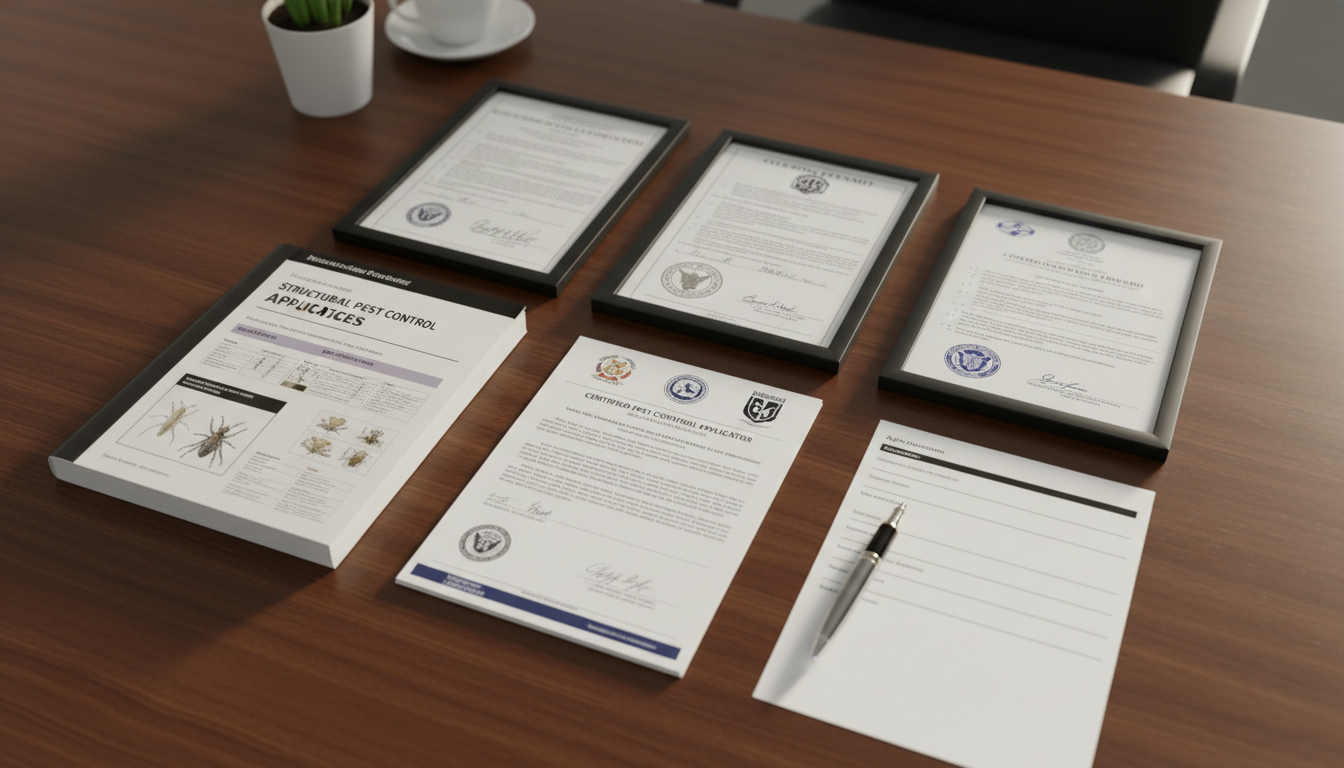
Pest Control Licensing Requirements by State: A Complete 2026 Guide
Getting licensed is the single biggest barrier to entry in the pest control industry — and that's actually a good thing. Licensing requirements protect the public, protect the environment, and protect you from unqualified competitors who'd otherwise undercut your prices with sloppy, unsafe work.
But navigating the licensing process can be genuinely confusing. There's no single national license. Instead, the EPA sets federal certification standards, and each state implements its own version with additional requirements. The result is 50 different systems, each with its own categories, exams, fees, and renewal schedules.
This guide breaks down the federal framework, walks through specific state examples, and gives you a clear roadmap to getting properly licensed — wherever you plan to operate.
50 States, 50 Systems
Every state has unique pest control licensing requirements built on the federal EPA framework
The Federal Foundation: EPA Certification Standards
The EPA establishes minimum certification standards under 40 CFR Part 171. These federal rules create the framework that every state must meet or exceed. Here are the key elements:
Two Types of Applicators
- Private Applicators — apply restricted-use pesticides (RUPs) for purposes of producing agricultural commodities on their own or employer's property. Less relevant for pest control businesses.
- Commercial Applicators — apply or supervise the application of RUPs for any purpose other than private application. This is the category you need for a pest control business.
10 Federal Certification Categories
The EPA defines 10 categories of commercial applicator certification. States may add categories, but these are the federal baseline:
| Category | Description | Relevant to Pest Control? |
|---|---|---|
| 1. Agricultural Pest Control (Plant) | Crops and agricultural land | No |
| 2. Agricultural Pest Control (Animal) | Livestock and confined animals | No |
| 3. Forest Pest Control | Forests and woodlands | Rarely |
| 4. Ornamental & Turf | Lawns, gardens, ornamental plants | Yes (lawn services) |
| 5. Aquatic Pest Control | Standing or running water | Niche (mosquito control) |
| 6. Right-of-Way | Roads, railways, power lines | No |
| 7. Industrial/Institutional/Structural | Buildings and structures | Primary category |
| 8. Public Health | Public health programs | Sometimes |
| 9. Regulatory Pest Control | Government pest programs | Rarely |
| 10. Demonstration & Research | Research and demonstrations | No |
For a standard pest control business, Category 7 (Industrial, Institutional, and Structural Pest Control) is your primary certification. If you also offer lawn and ornamental services, you'll need Category 4 as well. Many operators add categories over time as they expand their service offerings.
Federal Minimum Requirements
- Minimum age: 18 years old for all pesticide applicators seeking certification and for non-certified applicators using RUPs under direct supervision
- Recertification interval: Maximum of 5 years for both commercial and private applicators
- Competency standards: Applicators must demonstrate competency through written examinations covering pesticide safety, application techniques, labeling, environmental protection, and pest management
- Supervision requirements: Non-certified applicators may apply general-use pesticides under the supervision of a certified applicator, but RUPs require direct supervision
Important — 2024-2026 Regulatory Updates
In November 2024, updated federal certification and training regulations took effect, establishing enhanced pesticide safety training requirements and stricter standards for supervising non-certified applicators. Several states are still implementing these changes. Contact your state's pesticide regulatory agency for the most current requirements specific to your area.
State-by-State Breakdown: Key States
Every state layer additional requirements on top of the federal framework. Below are detailed breakdowns for the states with the most pest control operators, followed by a quick-reference table for all 50 states.
Florida
Florida has one of the most demanding licensing processes in the country — but also one of the strongest pest control markets due to year-round pest pressure.
- Regulatory body: Florida Department of Agriculture and Consumer Services (FDACS)
- License types: Pest Control Operator License (required to run a business) and Certified Operator Identification Card (individual certification)
- Prerequisites: Must be 18+, hold a high school diploma or equivalent, and have 3 years of experience working under a licensed pest control operator in the specific field you're applying for — with at least 1 year in Florida
- Exam: Written examination covering general pest control knowledge and your specific category (General Household Pest, Termite/WDO, Fumigation, Lawn & Ornamental)
- Application fee: $300
- Continuing education: 4 CEUs annually for Certified Operators
- Business requirements: Must carry liability insurance and post a surety bond
Pro Tip
Florida's 3-year experience requirement is one of the strictest in the country. If you're new to the industry, plan to work for an established company first while you accumulate the required experience. This isn't wasted time — it's invaluable on-the-job training that will make you a better business owner.
Texas
- Regulatory body: Texas Department of Agriculture (TDA), Structural Pest Control Service
- License types: Certified Commercial Applicator (individual) and Business License (company)
- Categories: Category 1 (Pest Control) is required for structural pest control. Additional categories include Termite, Lawn & Ornamental, and Fumigation
- Prerequisites: Must be 18+, pass a criminal background check, complete pre-licensing training
- Exam: Must pass the general standards exam plus each category-specific exam
- Continuing education: Varies by license type; typically 12-16 CEU hours per renewal cycle
- Renewal: Annual renewal required
California
- Regulatory body: California Department of Pesticide Regulation (DPR) and Structural Pest Control Board (SPCB)
- License types: Branch Registration (for businesses), Operator License, and Field Representative License
- Unique requirement: California separates structural pest control into two branches — Branch 1 (Fumigation), Branch 2 (General Pest), and Branch 3 (Termite/Wood-Destroying Organisms). You can be licensed in one, two, or all three
- Prerequisites: Varies by license type. Operator license requires 2 years of experience under a licensed operator, plus coursework. Field Representative requires passing an exam
- Exam: Multiple exams depending on branch and license type
- Continuing education: Required for all license types, with specific hour requirements per renewal cycle
New York
- Regulatory body: New York State Department of Environmental Conservation (DEC)
- License types: Commercial Pesticide Applicator, Commercial Pesticide Technician, and Pest Control Business Registration
- Categories: Category 7A (General Pest Control), Category 7B (Fumigation), Category 7C (Termite Control), and others
- Prerequisites: Must pass core exam plus category-specific exams. 30-hour course required for new commercial applicators
- Exam: Administered by Cornell University's Pesticide Management Education Program
- Continuing education: Required for recertification
- Business registration: Separate registration required to operate a pest control business, including proof of insurance
Georgia
- Regulatory body: Georgia Department of Agriculture, Structural Pest Control Commission
- License types: Certified Pest Control Operator (CPO) and Registered Technician
- Categories: Household Pest Control, WDO/Termite, Fumigation
- Prerequisites: 2 years of verifiable experience or a qualifying degree
- Exam: Written examination administered by the state
- Continuing education: 6 CEUs per year
Quick-Reference: All 50 States
The table below provides a high-level overview of licensing requirements across all 50 states. Requirements change frequently — always verify current details directly with your state's regulatory agency before beginning the licensing process.
| State | Regulatory Agency | Experience Required? | Exam Required? |
|---|---|---|---|
| Alabama | Dept. of Agriculture & Industries | Yes | Yes |
| Alaska | Dept. of Environmental Conservation | Varies | Yes |
| Arizona | Office of Pest Management | Yes (2 years) | Yes |
| Arkansas | State Plant Board | Yes | Yes |
| California | Structural Pest Control Board / DPR | Yes (2 years) | Yes |
| Colorado | Dept. of Agriculture | Varies | Yes |
| Connecticut | Dept. of Energy & Environmental Protection | Yes | Yes |
| Delaware | Dept. of Agriculture | Varies | Yes |
| Florida | FDACS | Yes (3 years) | Yes |
| Georgia | Dept. of Agriculture | Yes (2 years) | Yes |
| Hawaii | Dept. of Agriculture | Varies | Yes |
| Idaho | Dept. of Agriculture | Varies | Yes |
| Illinois | Dept. of Public Health | Yes | Yes |
| Indiana | Office of the State Chemist | Varies | Yes |
| Iowa | Dept. of Agriculture | Varies | Yes |
| Kansas | Dept. of Agriculture | Varies | Yes |
| Kentucky | Dept. of Agriculture | Yes | Yes |
| Louisiana | Dept. of Agriculture & Forestry | Yes | Yes |
| Maine | Board of Pesticides Control | Varies | Yes |
| Maryland | Dept. of Agriculture | Yes | Yes |
| Massachusetts | Dept. of Agricultural Resources | Yes | Yes |
| Michigan | Dept. of Agriculture & Rural Development | Varies | Yes |
| Minnesota | Dept. of Agriculture | Varies | Yes |
| Mississippi | Dept. of Agriculture & Commerce | Yes | Yes |
| Missouri | Dept. of Agriculture | Varies | Yes |
| Montana | Dept. of Agriculture | Varies | Yes |
| Nebraska | Dept. of Agriculture | Varies | Yes |
| Nevada | Dept. of Agriculture | Yes | Yes |
| New Hampshire | Div. of Pesticide Control | Varies | Yes |
| New Jersey | Dept. of Environmental Protection | Yes | Yes |
| New Mexico | Dept. of Agriculture | Varies | Yes |
| New York | Dept. of Environmental Conservation | Yes (30-hr course) | Yes |
| North Carolina | Dept. of Agriculture & Consumer Services | Yes | Yes |
| North Dakota | Dept. of Agriculture | Varies | Yes |
| Ohio | Dept. of Agriculture | Varies | Yes |
| Oklahoma | Dept. of Agriculture | Yes | Yes |
| Oregon | Dept. of Agriculture | Varies | Yes |
| Pennsylvania | Dept. of Agriculture | Yes | Yes |
| Rhode Island | Dept. of Environmental Management | Varies | Yes |
| South Carolina | Dept. of Pesticide Regulation | Yes | Yes |
| South Dakota | Dept. of Agriculture & Natural Resources | Varies | Yes |
| Tennessee | Dept. of Agriculture | Yes | Yes |
| Texas | Dept. of Agriculture | Varies by category | Yes |
| Utah | Dept. of Agriculture & Food | Varies | Yes |
| Vermont | Agency of Agriculture | Varies | Yes |
| Virginia | Dept. of Agriculture & Consumer Services | Yes | Yes |
| Washington | Dept. of Agriculture | Varies | Yes |
| West Virginia | Dept. of Agriculture | Varies | Yes |
| Wisconsin | Dept. of Agriculture, Trade & Consumer Protection | Varies | Yes |
| Wyoming | Dept. of Agriculture | Varies | Yes |
The Licensing Process: Step by Step
Regardless of your state, the general process follows the same pattern:
Step 1: Determine Which Licenses You Need
Contact your state's pesticide regulatory agency (see table above) and identify:
- Which certification categories apply to your planned services
- Whether you need an individual applicator license, a business license, or both (usually both)
- Any prerequisite experience or education requirements
Step 2: Meet Prerequisites
Depending on your state, this may include:
- Working under a licensed operator for 1-3 years
- Completing a state-approved training program
- Passing a background check
- Being at least 18 years old
Step 3: Study and Pass the Exam
Every state requires written examinations. Most states test on:
- Core/General exam: Pesticide safety, federal and state regulations, environmental protection, integrated pest management principles, application equipment
- Category-specific exam: Pest identification, treatment methods, and regulations specific to your certification category (e.g., structural pest control)
Pro Tip
The National Pest Management Association (NPMA) offers study guides and training materials aligned with state exam content. Many state extension programs (through universities like Purdue, Cornell, and UF) also offer free or low-cost study materials. Don't rely on memorization — understand the why behind each regulation, and the exam becomes straightforward.
Step 4: Apply for Your License
After passing the exam, submit your license application with:
- Application fee (typically $100-$500)
- Proof of passing exam scores
- Proof of insurance (for business licenses)
- Surety bond (if required by your state)
- Background check results
Step 5: Register Your Business
Most states require a separate business license/registration in addition to your individual applicator certification. This typically requires a designated Certified Operator to be associated with the business at all times.
Continuing Education Requirements
Getting licensed is only the beginning. Every state requires continuing education (CE) to maintain your certification. This ensures operators stay current on new products, changing regulations, and evolving best practices.
4-16 hrs
Typical Annual CE Requirement
1-5 Years
License Renewal Cycle
$50-$300
Typical Renewal Fee
Sources for approved continuing education include:
- State and regional pest management association conferences
- NPMA PestWorld annual conference
- Online CE providers (Univar Solutions, PCT, NPMA)
- University extension programs
- Manufacturer product training events
Common Compliance Mistakes (and How to Avoid Them)
Key Takeaway
Licensing violations can result in fines ranging from $1,000 to $25,000+ per incident, license suspension, and even criminal charges. Compliance isn't optional — it's the foundation of your business.
- Operating without proper licensing. This seems obvious, but it happens constantly — especially when operators expand into new service categories (like adding termite work) without obtaining the additional certification.
- Letting technicians apply RUPs unsupervised. Non-certified employees can apply general-use pesticides in most states, but restricted-use pesticides require direct supervision from a certified applicator. The definition of "direct supervision" varies by state — know yours.
- Falling behind on continuing education. Don't wait until the last month of your renewal cycle. Build CE into your annual schedule so you're never scrambling.
- Poor recordkeeping. Most states require detailed records of every pesticide application: date, location, product used, application rate, target pest, and applicator. Inspectors audit these records. Modern pest control software handles this automatically.
- Ignoring label requirements. "The label is the law" isn't just a saying — it's a legal requirement. Applying any pesticide in a manner inconsistent with its label directions is a violation of federal law under FIFRA.
- Not updating your business license when staff changes. If your designated Certified Operator leaves the company, you typically have a limited window (30-90 days depending on the state) to designate a new one or cease operations.
Multi-State Operations
If you plan to operate across state lines — or eventually scale your business into neighboring states — you'll need separate licenses in each state. There is no reciprocity between states, though some states have streamlined processes for applicators already licensed elsewhere.
For multi-state operations, consider:
- Each state's insurance and bonding requirements may differ
- CE requirements must be met independently for each state's license
- Product registrations vary by state — a pesticide approved in one state may not be registered for use in another
- Some states require a physical business location within their borders
Resources for Getting Started
- EPA — How to Get Certified as a Pesticide Applicator
- National Pest Management Association (NPMA) — Industry training, certification support, and advocacy
- Your state's Pesticide Safety Education Program (PSEP) — usually housed at the state's land-grant university
- Our complete guide to starting a pest control business — covers licensing as part of the full startup process
- Pest control insurance requirements — the other half of the compliance equation
Ready to explore the pest control landscape in your state? Browse our directory of 30,000+ pest control companies to see who's operating in your market, and join PestControlBusinesses.com for access to tools and resources that help you launch and grow your business.
Important
Licensing requirements change frequently. This guide was last updated in February 2026 and reflects the best available information at the time of publication. Always verify current requirements directly with your state's regulatory agency before making business decisions based on this information.
Related Articles
Why Pest Control Companies Are Booming: Industry Trends for 2026
Key Takeaways The U.S. pest control industry generates over $24 billion in annual revenue and has ...

Pest Control for New Homeowners: Your First-Year Checklist
Key Takeaways Schedule a professional pest inspection within the first 30 days of homeownership — ...
How Much Does Pest Control Cost in 2026? A Complete Pricing Guide
Key Takeaways The average one-time pest control treatment costs $150–$350, while quarterly service...