
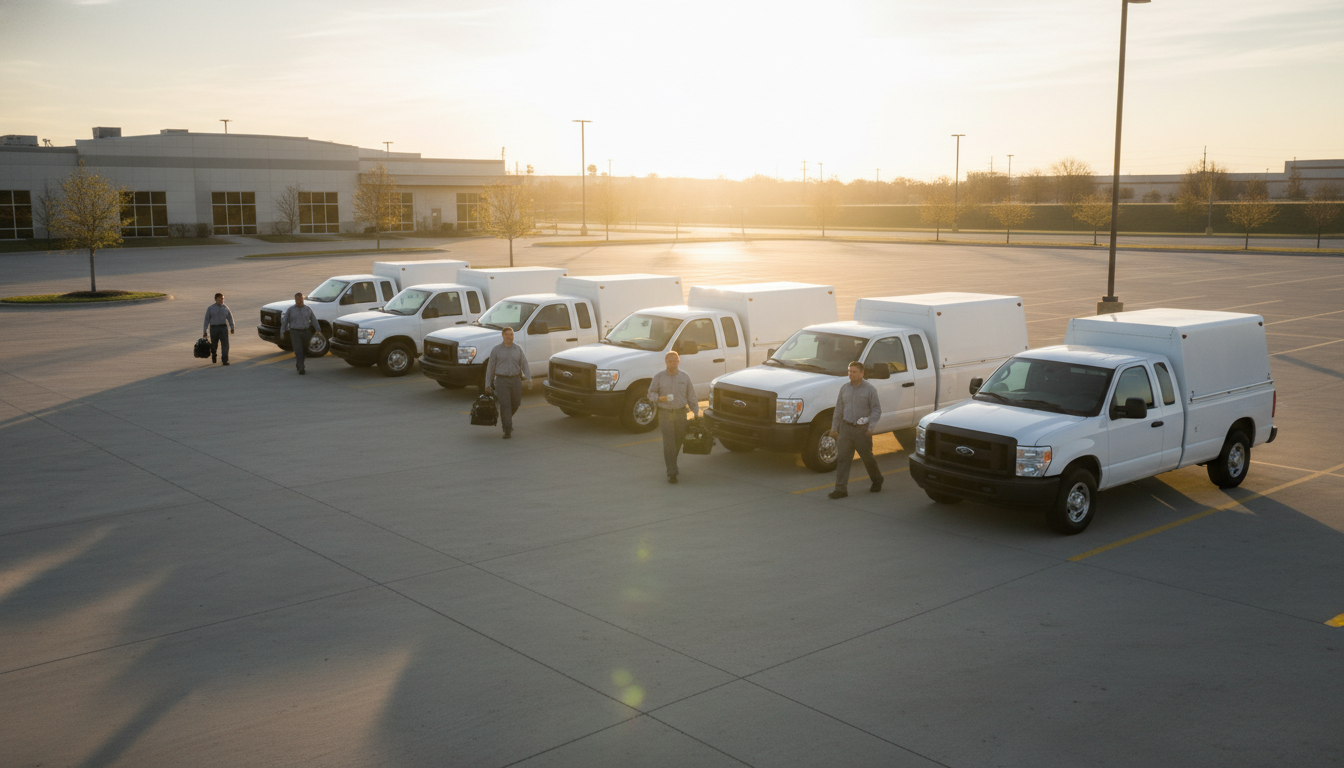
How to Scale a Pest Control Business from Solo Operator to Multi-Truck Fleet
There is a wall that every solo pest control operator hits. You are running 6-8 stops per day, personally handling every service call, answering every phone inquiry, sending every invoice, and maybe clearing $80,000-$120,000 a year. You know there is more revenue available — you are turning down calls because you are fully booked — but the idea of hiring, managing trucks, and building systems feels overwhelming.
Dozens of operators have navigated this exact transition successfully. The path from one-truck solo operator to a multi-truck fleet running $1 million or more in revenue is well-documented. It follows predictable stages with predictable challenges. Here is the playbook.
$250K
Solo Operator Revenue Ceiling
$500K
First Employee Milestone
$1M+
Multi-Truck Fleet Revenue
Stage 1: Maximizing Solo Revenue ($0 to $250K)
Before you hire anyone, you need to squeeze every dollar out of your solo operation. This does two things: it maximizes the cash you have available to fund growth, and it proves the business model works at full capacity. According to Sheets Market, well-optimized solo operators reach $250,000-$300,000 in annual revenue.
The Numbers at This Stage
- Target: 8 service stops per day, 5 days a week
- Average ticket: $55-$85 for residential quarterly service
- Recurring revenue goal: 70%+ of total revenue from recurring service contracts
- Profit margin: Solo operators with efficient routing and subscription models can achieve 45-58% EBITDA margins on $250K+ revenue, with capital expenditures under $50,000
What to Focus On
Route density. This is the single most impactful lever at every stage. Every minute driving between stops is a minute you are not making money. Focus your marketing on 2-3 ZIP codes maximum. Say no to jobs outside your zone — the math does not work at a solo level. Read our complete guide on pest control route optimization for specific strategies.
Recurring revenue. Convert every one-time customer to a quarterly or bi-monthly program. Your goal is a book of recurring contracts large enough that you are fully booked before the phone even rings in the morning. A base of 500-600 recurring residential accounts generates roughly $200K-$250K annually.
Pricing discipline. Do not compete on price. Compete on reliability, responsiveness, and quality. The operators who get stuck at $150K forever are usually the ones charging $35 for an initial service. Check our guide on how to price pest control services to make sure your pricing supports growth.
Pro Tip
Track three numbers obsessively at this stage: revenue per stop, stops per day, and recurring revenue percentage. If revenue per stop is below $60, raise prices. If stops per day is below 7, tighten your route density. If recurring revenue is below 60%, fix your sales process. These three metrics tell you exactly where the bottleneck is.
Stage 2: Hiring Your First Technician ($250K to $500K)
This is the hardest transition in the entire growth journey. You are going from doing everything yourself to trusting someone else with your customers, your reputation, and your truck. Most operators who fail to scale get stuck right here.
When to Pull the Trigger
Hire when you are consistently turning away work — not when you have a slow week and think, "I should get help." The right time is when you have been fully booked for at least 60-90 consecutive days and you have a waiting list of new customers you cannot service. At that point, the first hire pays for themselves almost immediately because you already have the demand.
The Financial Reality
| Expense | Monthly Cost | Annual Cost |
|---|---|---|
| Technician salary (loaded) | $3,500-$5,000 | $42,000-$60,000 |
| Vehicle (payment + insurance) | $800-$1,200 | $9,600-$14,400 |
| Equipment and materials | $400-$700 | $4,800-$8,400 |
| Software per-user costs | $50-$150 | $600-$1,800 |
| Total first-hire overhead | $4,750-$7,050 | $57,000-$84,600 |
Your first technician needs to generate $8,000-$12,000 per month in revenue to be profitable after covering their full loaded costs. At 6-8 stops per day with $55-$75 average tickets, that is achievable within 60-90 days of ramping up their route.
The SOP Imperative
Before your first technician touches a customer's property, you need written Standard Operating Procedures for everything:
- Service protocols for each pest type (general pest, rodent, termite, mosquito, etc.)
- Chemical mixing ratios and application methods
- Customer communication scripts (arrival notification, service summary, upsell opportunities)
- Vehicle maintenance and equipment checks
- Documentation and reporting requirements
- Safety protocols and PPE requirements
Your SOPs do not need to be perfect on day one. Start with a simple checklist format and improve over time. The point is to get the knowledge out of your head and into a system that produces consistent results regardless of who is performing the service.
Key Takeaway
Your first hire should NOT be your weakest area — it should be a technician who can take over your route while you focus on sales and operations. The biggest mistake solo operators make is hiring an office person first. You need revenue production, not administrative help. Answer your own phone for a while longer. You cannot afford an office employee until you have 2-3 technicians generating revenue.
Stage 3: Building the Team ($500K to $1M)
Once your first technician is productive and your SOPs are working, adding technicians 2, 3, and 4 follows a repeatable pattern. This is where the business starts feeling like a real company instead of a job with employees.
The Revenue-per-Technician Formula
A well-run pest control operation generates $15,000-$25,000 per technician per month, or $180,000-$300,000 per technician per year. That means reaching $1 million in revenue requires 4-6 productive technicians, depending on your market, service mix, and pricing.
$15K-$25K
Revenue per Technician per Month
4-6
Technicians Needed for $1M Revenue
10-20%
Net Profit Margin at Scale
Adding Service Lines for Growth
At this stage, expanding your service offerings accelerates growth without proportionally increasing your customer acquisition costs. Consider adding:
- Termite inspections and treatments: High-margin, often $800-$2,500 per job, with annual renewal contracts.
- Mosquito and tick programs: Seasonal recurring revenue that fills spring and summer capacity.
- Wildlife exclusion: Raccoons, squirrels, bats. Higher ticket prices ($300-$1,500) and lower competition.
- Commercial accounts: Transitioning into commercial pest control adds high-value recurring contracts that stabilize revenue year-round.
- Insulation services: TAP (Thermal Acoustical Pest Control) insulation generates $1,500-$4,000 per install and prevents pest intrusion.
The Route Density Strategy at Scale
As you add technicians, route density becomes even more critical. Here is the approach that works:
- Assign geographic territories. Each technician owns a defined service area. No crisscrossing.
- Market in clusters. Focus your marketing spend and SEO efforts on neighborhoods where you already have density, not on the other side of town.
- Grow the territory outward. Only expand a technician's territory after you have saturated the core area with at least 15-20 accounts per ZIP code.
Stage 4: Transitioning from Operator to Manager ($1M+)
This is the second-hardest transition after your first hire. At $1 million in revenue, you physically cannot do everything. You have to stop being the best technician and start being the leader who builds the company.
Get Off the Truck
If you are still running a daily route at $1M in revenue, you are the bottleneck. Your time is worth more recruiting, training, selling commercial accounts, and improving operations than it is spraying baseboards. It is hard to let go. But every hour you spend on a route is an hour you are not spending growing the business.
Key Hires at This Stage
- Office manager/scheduler: Now is the time. With 4-6 technicians, scheduling, customer service, and billing require a dedicated person.
- Sales representative: A dedicated salesperson focused on commercial accounts and large residential projects can drive growth that you can no longer generate alone.
- Field supervisor: Promote your best technician to a lead role. They do quality checks, handle callbacks, train new hires, and keep service standards high.
Important
The transition from operator to manager often causes a temporary dip in profit margins. This is normal. You are adding overhead (office staff, management) before the revenue fully catches up. Budget for 6-12 months of compressed margins during this transition. If you panic and cut costs too early, you will be stuck as a $700K company forever.
Financing Growth: How to Fund the Expansion
Scaling from solo to fleet requires capital. Here are the realistic funding options, ranked by cost and accessibility:
- Reinvested profits: The cheapest money is money you already earned. At 45-58% margins as a solo operator, you should be banking $50,000-$100,000 annually to fund growth. This is your primary funding source for your first 2-3 hires.
- Equipment financing: Vehicles and spray rigs can be financed through equipment loans at 5-9% APR. The equipment serves as collateral, making approval easier than unsecured loans.
- SBA microloans: The SBA microloan program offers up to $50,000 for small businesses, with more flexible qualification requirements than traditional bank loans.
- Business line of credit: Once you have 2+ years of tax returns showing consistent revenue, a $25,000-$100,000 line of credit provides working capital flexibility for seasonal fluctuations and unexpected growth opportunities.
- Acquisition financing: At $500K+ revenue, you can consider acquiring a smaller competitor's book of business using seller financing or SBA 7(a) loans. Buying 200-300 existing accounts is often faster than acquiring them organically.
Pro Tip
Never fund growth with credit cards or high-interest merchant cash advances. The pest control business has seasonal revenue fluctuations, and expensive debt during a slow January can create a cash crisis that kills an otherwise healthy company. Patient, low-cost capital wins the long game.
The Technology Stack for Scale
You cannot scale a pest control business on spreadsheets and memory. By the time you have 3+ technicians, you need:
- Field service management software: PestPac, FieldRoutes, Briostack, or similar. This handles scheduling, dispatching, invoicing, and customer communication. Read our best pest control software review.
- Route optimization: Built into most pest control software platforms. Saves 20-40% on fuel and increases stops per day by 2-3.
- GPS fleet tracking: Know where every truck is in real time. This is not about spying on technicians — it is about dispatching the closest truck for emergency calls and verifying service completion.
- Automated payment processing: Auto-charge recurring customers. Manual invoicing and check collection do not scale beyond 500 accounts.
- CRM and marketing automation: Track leads, automate follow-ups, and measure customer acquisition costs by channel.
Common Mistakes That Kill Scaling Efforts
Industry data shows that more pest control businesses fail to scale than succeed. Here are the patterns:
- Hiring too fast without demand. Adding technicians before you have routes to fill them creates a cash drain that can be fatal. Always hire behind demand, not ahead of it.
- Ignoring route density. Accepting every job regardless of location destroys efficiency. A technician doing 5 scattered stops across town produces less revenue than one doing 8 clustered stops.
- No SOPs before hiring. Your first technician creates their own habits. If those habits are not aligned with your standards, you have a rogue operator representing your company.
- Competing on price during growth. Cutting prices to fill new technician routes is a death spiral. You need profitable growth, not growth for the sake of growth.
- Owner doing technician work at $1M. Every hour on a truck at this stage costs you $200+ in lost management productivity.
The Growth Timeline: What to Expect
| Milestone | Revenue | Team Size | Typical Timeline |
|---|---|---|---|
| Maxed-out solo operator | $200K-$300K | Just you | Years 1-3 |
| First hire productive | $350K-$500K | You + 1 tech | Years 3-4 |
| Small team running | $500K-$750K | You + 2-3 techs | Years 4-5 |
| Owner off the truck | $750K-$1M | 3-5 techs + office | Years 5-7 |
| Established fleet | $1M-$2M | 5-8 techs + management | Years 7-10 |
These timelines assume organic growth. Acquiring a competitor's book of business can compress each stage by 12-18 months.
Key Takeaway
Scaling a pest control business is not about doing more of the same — it is about building systems, hiring the right people, and gradually removing yourself from daily operations. The revenue milestones are predictable. The challenges at each stage are known. The operators who scale successfully are the ones who prepare for the next stage before they arrive at it.
Ready to benchmark your business against these growth stages? Use our free Valuation Calculator to see where your company stands, or browse our directory of 30,000+ pest control companies to see how operators in your market are growing.
Related Articles
Why Pest Control Companies Are Booming: Industry Trends for 2026
Key Takeaways The U.S. pest control industry generates over $24 billion in annual revenue and has ...

Pest Control for New Homeowners: Your First-Year Checklist
Key Takeaways Schedule a professional pest inspection within the first 30 days of homeownership — ...
How Much Does Pest Control Cost in 2026? A Complete Pricing Guide
Key Takeaways The average one-time pest control treatment costs $150–$350, while quarterly service...