
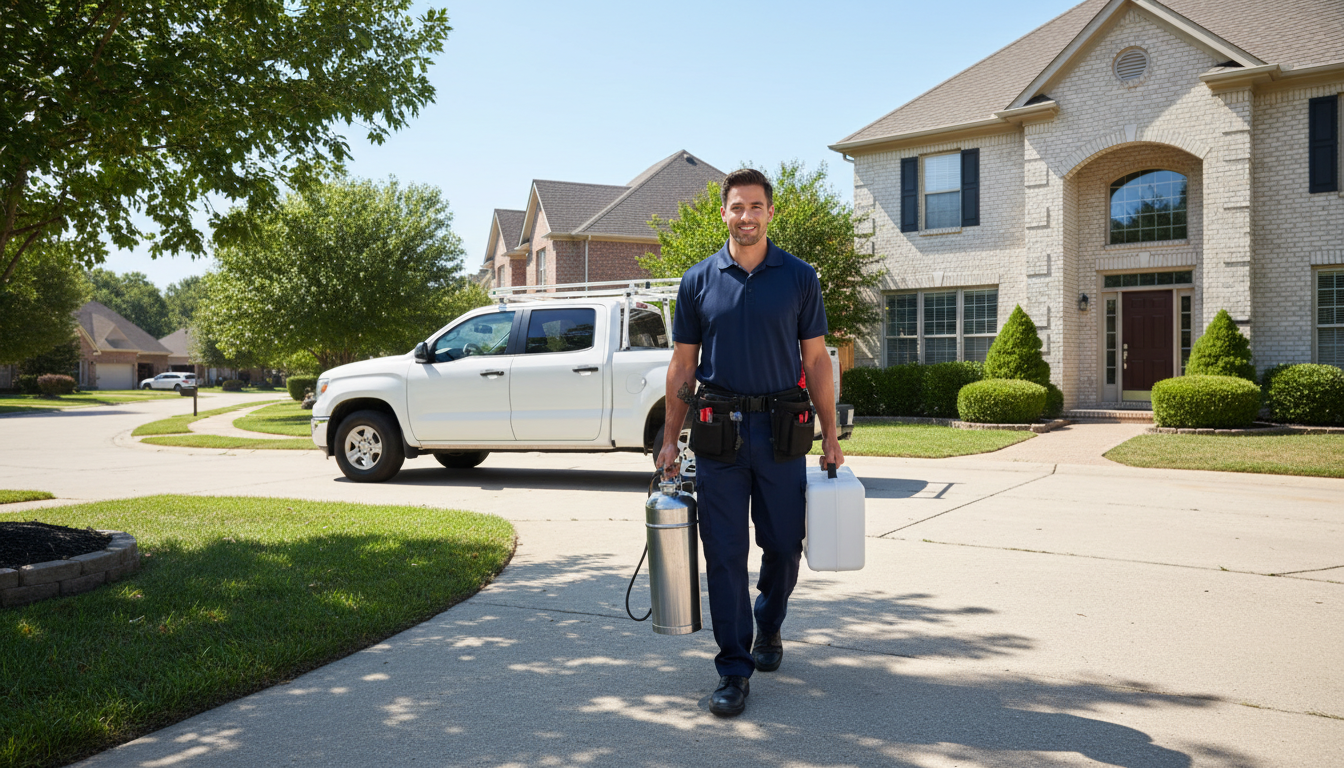
Pest Control Marketing: 10 Proven Strategies to Get More Customers
Here is something most marketing agencies will not tell you: 80% of the money pest control companies spend on marketing is wasted. Not because the channels don't work, but because operators spread their budgets too thin, chase shiny tactics, and don't track what actually generates paying customers.
This isn't a list of vague marketing ideas. These are the 10 strategies that consistently deliver the highest ROI for pest control businesses, ranked roughly by cost-effectiveness. The guide includes real cost-per-lead data, conversion benchmarks, and the specific mistakes that burn through budgets without results.
$10-$70
Cost Per Lead Range
5-10%
Revenue to Marketing Budget
550%
Long-Term SEO ROI
How Much Should You Spend on Pest Control Marketing?
Before diving into tactics, let's set a budget framework. The industry standard is 5-10% of gross revenue, but the right number depends on your growth stage:
- Startup (Year 1-2): 10-15% of revenue. You're buying awareness from zero.
- Growth (Year 3-5): 7-10% of revenue. You have some referrals and repeat business, but still need paid channels.
- Established ($1M+): 5-8% of revenue. Your brand has traction, referrals are significant, and you're optimizing rather than discovering channels.
For a company doing $500K in revenue, that's $25,000-$50,000 per year in marketing -- or roughly $2,000-$4,000 per month. That's enough to run a focused strategy across 2-3 channels. It's not enough to do everything on this list simultaneously.
1. Google Business Profile Optimization (Free)
Your Google Business Profile (GBP) is the single most important marketing asset you own, and it costs nothing. When someone searches "pest control near me," the Local 3-Pack that appears above organic results pulls directly from GBP listings. If you're not in those three slots, you're invisible to the highest-intent customers in your market.
What to do:
- Complete every field in your profile -- business hours, service area (up to 20 cities), service categories, attributes
- Add 20+ high-quality photos: your truck, uniformed technicians, before/after results, your office
- Post weekly updates -- seasonal pest tips, special offers, new service announcements
- Respond to every review within 24 hours, positive or negative
- Add your services with descriptions and pricing ranges
The review game: Reviews are the primary ranking factor for the Local 3-Pack. You need a system to generate them consistently. The simplest approach: your technician sends a review request text (via your pest control software) immediately after completing service, while the customer is still standing in a pest-free kitchen. Aim for 5-10 new reviews per month minimum.
For a complete deep dive on dominating local search, read our guide on pest control local SEO.
Pro Tip
The companies in the Local 3-Pack typically have 100+ reviews with a 4.5+ average rating. If you're at 20 reviews, your first marketing priority isn't ads or SEO -- it's a systematic review generation program. Nothing else matters until your review count is competitive.
2. Google Local Services Ads (LSAs)
Local Services Ads sit at the very top of Google search results -- above regular ads, above organic results. They display your Google Guaranteed badge, your review rating, and a direct call button. For pest control, they're the highest-converting paid channel available.
Cost: Pay-per-lead model at $20-$70 per lead depending on your market. Low-competition rural/suburban markets run $20-$35. Mid-size cities with competition run $35-$60. Major metros can push past $70.
Why they work:
- You only pay for actual leads (calls or messages), not clicks
- The Google Guaranteed badge builds instant trust
- Conversion rates are roughly 3x higher than traditional Google Ads because intent is extremely high
- You can dispute irrelevant leads and get credits
How to set them up right:
- Get Google Guaranteed verified (background check and insurance verification required)
- Set your weekly budget based on how many leads you can actually handle. Start at $500-$1,000/week and adjust.
- Respond to every lead within 5 minutes -- response time directly affects your ranking in LSA results
- Track which leads convert to paying customers, not just call volume
Important
LSAs only work if you answer the phone. Seriously. If your response time is over 15 minutes, Google will show your competitors instead. If you can't answer calls during business hours consistently, fix that problem before spending a dollar on LSAs. A dedicated CSR or answering service is a prerequisite, not an option.
3. Local SEO and Website Content
SEO is the long game that pays the biggest dividends. According to marketing data, SEO generates roughly 550% ROI over time -- but it takes 6-12 months to see meaningful results. The companies willing to invest upfront dominate their markets for years.
What to focus on:
- City-specific service pages: Create individual pages for every city you serve. "Pest Control in [City Name]" pages rank for local searches and convert at 3-5x the rate of generic service pages.
- Pest-specific content: Write pages targeting specific pests: "Termite Treatment in [City]," "Bed Bug Removal [City]," "Rodent Control [City]." These long-tail keywords have lower competition and higher conversion intent.
- Blog content: Publish 2-4 blog posts per month addressing common customer questions: "Are carpenter ants dangerous to my house?" "What attracts scorpions to my home?" This builds topical authority over time.
Cost: DIY is free but time-intensive. Hiring an SEO agency experienced with pest control runs $1,500-$3,500/month. Freelance content writers cost $100-$300 per article.
4. Google Ads (Pay-Per-Click)
Traditional Google Ads sit below LSAs in search results but remain a significant lead source. The key metric: pest control keywords like "exterminator near me" now average $34 per click in 2026 -- up from $28-$30 in 2024, a 10-13% year-over-year increase according to industry advertising data.
Making PPC profitable:
- Focus on high-intent keywords: "pest control near me," "exterminator [city]," "[pest type] removal [city]"
- Use negative keywords aggressively -- exclude "DIY," "home remedies," "salary," "jobs"
- Set up call tracking to attribute leads to specific campaigns and keywords
- Target specific service areas using radius or zip code targeting, not broad regions
- Run ads during business hours when you can answer the phone, pause them on weekends if you don't have weekend CSR coverage
Target cost per lead: $35-$70 for a properly optimized campaign. If your CPL is above $70 consistently, your campaign needs restructuring. If your average revenue per customer is $400+ (via recurring contracts), a $50 CPL delivers outstanding ROI.
5. Referral Programs
Referrals are the highest-quality leads in any service business. A referred customer has pre-built trust, a higher conversion rate (60-70% vs. 20-30% for cold leads), and a higher average lifetime value. Yet most pest control companies don't have a formal referral program.
What works:
- Cash incentives: $50 for the referrer, $25 off for the new customer. Simple, clear, effective.
- Technician-driven referrals: Have technicians hand the customer two business cards at every service: "If your neighbors ever have a bug problem, I'd appreciate the referral. We'll take $25 off your next service for anyone you send our way."
- Seasonal referral pushes: Double referral bonuses during slow months (November-February) to smooth out seasonal dips.
Cost per lead: Effectively $50-$75 (the referral bonus plus the discount), but with 60-70% conversion rates, your cost per customer is under $100. That's unbeatable.
Key Takeaway
The best referral programs are operationally integrated, not just marketing campaigns. Your technicians should mention the referral program at every single service call. Your software should automate referral tracking. And you should pay referral bonuses within 7 days -- delayed rewards kill referral motivation.
6. Vehicle Wraps
A fully wrapped pest control truck generates 30,000-70,000 visual impressions per day, according to the Outdoor Advertising Association. At a one-time cost of $2,500-$5,000 per truck, the cost per impression over a 5-year wrap life is essentially zero.
What makes an effective wrap:
- Your company name in large, readable text (visible from 50+ feet)
- Phone number in bold -- this is the call to action
- Clean design with 2-3 colors maximum. Avoid clutter.
- Your website URL and "Licensed & Insured" tagline
- Skip the clip-art bugs. Professional photography or clean vector graphics only.
The indirect benefit: Wrapped trucks parked in residential driveways signal to neighbors that a professional service is happening nearby. This "neighborhood effect" generates 2-5 inquiries per month per truck from neighbors who see your vehicle and think, "I should call them too."
7. Social Media Marketing
Social media isn't the lead generation machine that Google is for pest control, but it serves two critical functions: brand awareness and trust building. The cost per lead from social media advertising runs $50-$80 -- higher than search -- but organic social is nearly free and builds long-term credibility.
What actually works on social media for pest control:
- Before/after photos and videos: A termite damage reveal or a wasp nest removal video generates engagement that no stock photo ever will
- Educational content: "3 signs you have termites" posts drive shares and position you as the local expert
- Customer testimonials: Short video testimonials from happy customers outperform any ad creative
- Behind-the-scenes content: Show your team, your training, your trucks. People buy from people they feel they know.
What doesn't work: Paid social ads trying to generate cold leads. Facebook and Instagram users aren't searching for pest control -- they're scrolling. Save your ad budget for Google where intent is high.
Pro Tip
Facebook neighborhood groups are a hidden gold mine. Join every local community group in your service area. When someone posts asking for pest control recommendations, your existing customers will tag you -- but only if you've built a brand they're proud to recommend. That organic word-of-mouth in local groups converts better than any ad.
8. Door-to-Door Sales
Door-to-door (D2D) gets a bad reputation, but it remains one of the most effective customer acquisition strategies in residential pest control, particularly for building a route density that keeps your operations efficient. Companies like Aptive and Moxie built billion-dollar businesses on D2D.
The economics:
- A good D2D rep closes 3-6 accounts per day
- Average cost per acquisition: $100-$150 (including rep compensation)
- The customers you acquire through D2D cluster geographically, which means denser routes and lower service costs
Making D2D work in 2026:
- Professional appearance is non-negotiable -- uniforms, badges, branded tablets
- Lead with value, not fear. "We're treating several homes in this neighborhood this week" works better than "You probably have bugs"
- Offer a free inspection as the foot-in-the-door, then present contract options on-site
- Use software like Pocomos that has dedicated D2D sales management tools
9. Community Sponsorships and Local Partnerships
Sponsoring little league teams, local 5K races, HOA newsletters, and community events doesn't generate direct leads -- but it builds brand recognition that makes every other marketing channel work better. When someone sees your Google ad and recognizes your name from their kid's baseball league, the click-through and conversion rates go up.
Cost-effective sponsorship ideas:
- Youth sports team sponsorship: $200-$500/season for jersey placement
- HOA newsletter advertising: $50-$150/month for a targeted, hyper-local audience
- Real estate agent partnerships: Offer home inspection pest reports for real estate agents. Every home sale is a potential new customer.
- Property management partnerships: Offer volume discounts to property managers in exchange for being their exclusive pest provider
For more on building commercial pest control contracts through partnerships, see our dedicated guide.
10. Direct Mail
Direct mail is the least exciting strategy on this list, and it still works -- especially in specific scenarios. The response rate for direct mail to residential addresses runs 1-3%, which sounds low until you realize you can target 5,000 homes in your ideal service area for $2,000-$3,000.
When direct mail works best:
- New market entry -- when you're expanding into a new city or zip code and have zero brand awareness
- Seasonal pushes -- a termite season postcard in March or a rodent exclusion mailer in October
- Targeting specific neighborhoods where you already have route density and want to fill gaps
Design tips: Oversized postcards (6x9 or larger) outperform standard mailers. Include a specific offer with a deadline: "$50 off your first quarterly service -- call by March 31." Track with a unique phone number or promo code.
Building Your Marketing Stack: Where to Start
You can't do all 10 at once, and you shouldn't try. Here's the priority order based on your budget:
| Monthly Budget | Priority Channels | Expected Monthly Leads |
|---|---|---|
| $500-$1,000 | GBP optimization, review generation, referral program | 10-25 |
| $1,000-$2,500 | Above + Google LSAs + vehicle wrap (one-time) | 25-50 |
| $2,500-$5,000 | Above + Google Ads + local SEO content | 50-100 |
| $5,000+ | Above + D2D team + community sponsorships + social media | 100-200+ |
Key Takeaway
The companies that win at marketing aren't the ones that spend the most. They're the ones that track everything, double down on what works, and cut what doesn't. Set up call tracking from day one. Know your cost per lead and cost per customer for every channel. Review the numbers monthly. Marketing without measurement is just spending money and hoping.
Tracking and Measuring Marketing ROI
Every dollar you spend on marketing should be traceable to a result. Here's the minimum tracking infrastructure you need:
- Call tracking: Use a service like CallRail or CallTrackingMetrics to assign unique phone numbers to each marketing channel. This is the only way to know which channels are actually generating calls.
- CRM tracking: When a lead calls, your booking team should ask "How did you hear about us?" and log the source in your pest control CRM.
- Cost per lead by channel: Monthly marketing spend per channel divided by leads generated. If your Google Ads spend is $2,000 and generates 40 leads, your CPL is $50.
- Cost per customer: Factor in conversion rate. If 40 leads convert to 12 customers, your cost per customer is $167.
- Customer lifetime value: If your average customer stays 3 years at $360/year, the LTV is $1,080. Compare that to your cost per customer to calculate true ROI.
Use our ROI Estimator to model the impact of different marketing strategies on your bottom line, and browse our directory of 30,000+ pest control companies to see how top operators in your market position themselves.
Pro Tip
Review your marketing performance quarterly, but don't make drastic changes based on a single bad month. SEO takes 6-12 months. Google Ads need 2-3 months of optimization. Even referral programs take a quarter to build momentum. Give each channel enough time to prove itself before pulling the plug.
The pest control companies growing fastest in 2026 aren't the ones with the biggest marketing budgets. They're the ones with the most disciplined approach: focused channels, rigorous tracking, and the patience to let compound growth do its work. Pick your top 2-3 channels, execute them well, measure everything, and scale what works.
Related Articles
Why Pest Control Companies Are Booming: Industry Trends for 2026
Key Takeaways The U.S. pest control industry generates over $24 billion in annual revenue and has ...
Pest Control for New Homeowners: Your First-Year Checklist
Key Takeaways Schedule a professional pest inspection within the first 30 days of homeownership — ...
How Much Does Pest Control Cost in 2026? A Complete Pricing Guide
Key Takeaways The average one-time pest control treatment costs $150–$350, while quarterly service...