
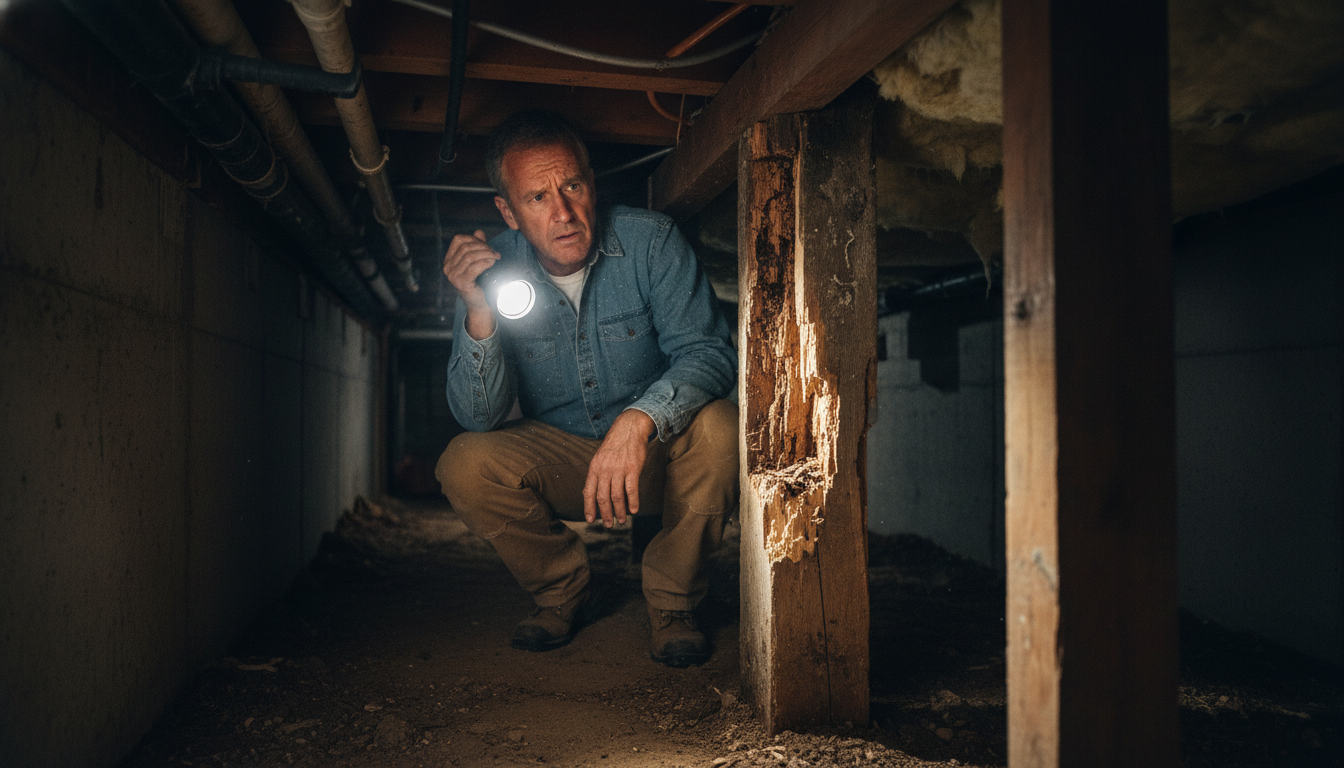
Termites vs. Your Home's Value: The $5 Billion Problem Homeowners Ignore
- Termites damage approximately 600,000 U.S. homes annually, costing an estimated $5 billion in treatment and repairs.
- Homes with documented termite damage sell for 20–25% below comparable properties, according to real estate industry data.
- Standard homeowner's insurance policies almost never cover termite damage — it is classified as "preventable maintenance."
- Annual termite prevention contracts ($150–$400/year) offer significant ROI compared to average repair costs of $3,000–$8,000.
- Disclosure laws in most states require sellers to report known termite damage or active infestations.
Termites operate in silence. They work behind walls, beneath floors, and inside structural framing — often for years — before any visible evidence reaches the surface. By the time most homeowners discover an infestation, the damage is already significant. According to data from the National Pest Management Association (NPMA), termites damage roughly 600,000 homes in the United States every year, and Americans collectively spend approximately $5 billion annually on termite control and damage repair.
Unlike a leaky roof or a cracked foundation, termite damage is both invisible and specifically excluded from most insurance policies. This combination makes termites one of the most financially dangerous threats a homeowner can face — and one of the most commonly underestimated.
The Financial Impact on Home Value
Real estate data consistently shows that homes with termite damage — even damage that has been repaired — sell at a significant discount. According to multiple real estate industry analyses, homes with documented termite damage sell for 20–25% below comparable properties in the same market.
For context, on a $350,000 home, that discount represents $70,000 to $87,500 in lost value — far exceeding what prevention or early treatment would have cost.
The impact extends beyond the sale price:
- Longer time on market — Homes with termite history average 30–60 additional days before selling
- Reduced buyer pool — Many buyers and lenders require a clear termite inspection letter (Wood Destroying Insect Report) before closing
- Negotiation leverage — Buyers routinely use termite findings to negotiate $5,000–$15,000 in credits or price reductions, even for minor issues
- Refinancing complications — VA and FHA loans require clear termite inspections, which can delay or prevent refinancing
The Insurance Gap
One of the most consequential facts about termite damage is that standard homeowner's insurance policies do not cover it. Insurance companies classify termite damage as a maintenance issue — something the homeowner should have prevented through regular inspections and treatment.
This exclusion applies across virtually all major carriers and policy types. Some specific scenarios to understand:
| Scenario | Covered? | Notes |
|---|---|---|
| Termite damage to structural framing | No | Classified as preventable maintenance |
| Collapse caused by termite damage | Rarely | May be covered if collapse is sudden and accidental |
| Fire caused by termites damaging wiring | Yes (fire) | The fire is covered; the termite damage that caused it is not |
| Termite treatment costs | No | Treatment is the homeowner's responsibility |
Repair Costs: What Homeowners Actually Pay
According to HomeAdvisor and industry data, the average cost of termite-related repairs ranges from $3,000 to $8,000, with severe cases reaching $15,000–$30,000 or more when structural members need replacement.
Common repair scenarios include:
- Subfloor replacement: $1,500–$5,000
- Floor joist repair or sistering: $2,000–$7,000
- Wall framing repair: $1,500–$4,500
- Roof truss repair: $3,000–$10,000
- Foundation sill plate replacement: $2,000–$6,000
These costs do not include the termite treatment itself, which ranges from $225 for a localized spot treatment to $2,500+ for a whole-home liquid barrier or bait system.
Prevention: The ROI Calculation
Annual termite prevention contracts — which include regular inspections and maintenance of bait stations or barrier treatments — typically cost $150–$400 per year. Over a 10-year period, that represents $1,500–$4,000 in total prevention costs.
Compare that to the potential cost of an undetected infestation:
| Approach | 10-Year Cost | Outcome |
|---|---|---|
| Annual prevention contract | $1,500–$4,000 | Early detection, minimal damage |
| No prevention + infestation | $3,225–$10,500+ | Treatment + repairs + lost home value |
Disclosure Laws and Legal Exposure
In most U.S. states, sellers are legally required to disclose known termite damage or active infestations. Failure to disclose can result in lawsuits, rescission of the sale, or mandated repairs at the seller's expense.
Key points about disclosure:
- Most states require a Wood Destroying Insect (WDI) inspection as part of the real estate transaction, particularly for VA and FHA loans
- Seller disclosure forms in virtually every state include specific questions about past or present termite activity
- Concealing known damage can expose sellers to fraud claims even after closing
- Some states require active treatment before transfer of title
Signs Every Homeowner Should Watch For
Because termite damage is typically hidden, routine awareness of warning signs is the first line of defense:
- Mud tubes on foundation walls — pencil-width tunnels made of soil and termite saliva
- Hollow-sounding wood when tapped with a screwdriver handle
- Doors and windows that suddenly stick — swelling from termite damage to framing
- Bubbling or warping paint that looks like water damage but has no moisture source
- Swarmers — winged termites emerging indoors, typically in spring, often mistaken for flying ants
- Discarded wings — found on windowsills or near light sources after a swarm
High-Risk Regions
Termite risk varies significantly by geography. The U.S. Department of Agriculture divides the country into termite infestation probability zones:
- Very heavy: Florida, Gulf Coast states, Hawaii, Southern California
- Heavy: Southeast, Mid-Atlantic, Texas, Southern Midwest
- Moderate: Northern Midwest, Mountain West, Pacific Northwest
- Slight to none: Alaska, extreme northern states
Homeowners in "very heavy" and "heavy" zones are generally advised to maintain continuous termite protection. In moderate zones, annual inspections without continuous treatment may be sufficient, depending on construction type and local conditions.
The data is clear: termite prevention is not a luxury — it is a financial safeguard for what is typically a household's largest asset. The cost of prevention is a fraction of the cost of repair, and the cost of repair is a fraction of the potential loss in home value.
Related Articles
Why Pest Control Companies Are Booming: Industry Trends for 2026
Key Takeaways The U.S. pest control industry generates over $24 billion in annual revenue and has ...

Pest Control for New Homeowners: Your First-Year Checklist
Key Takeaways Schedule a professional pest inspection within the first 30 days of homeownership — ...
How Much Does Pest Control Cost in 2026? A Complete Pricing Guide
Key Takeaways The average one-time pest control treatment costs $150–$350, while quarterly service...