
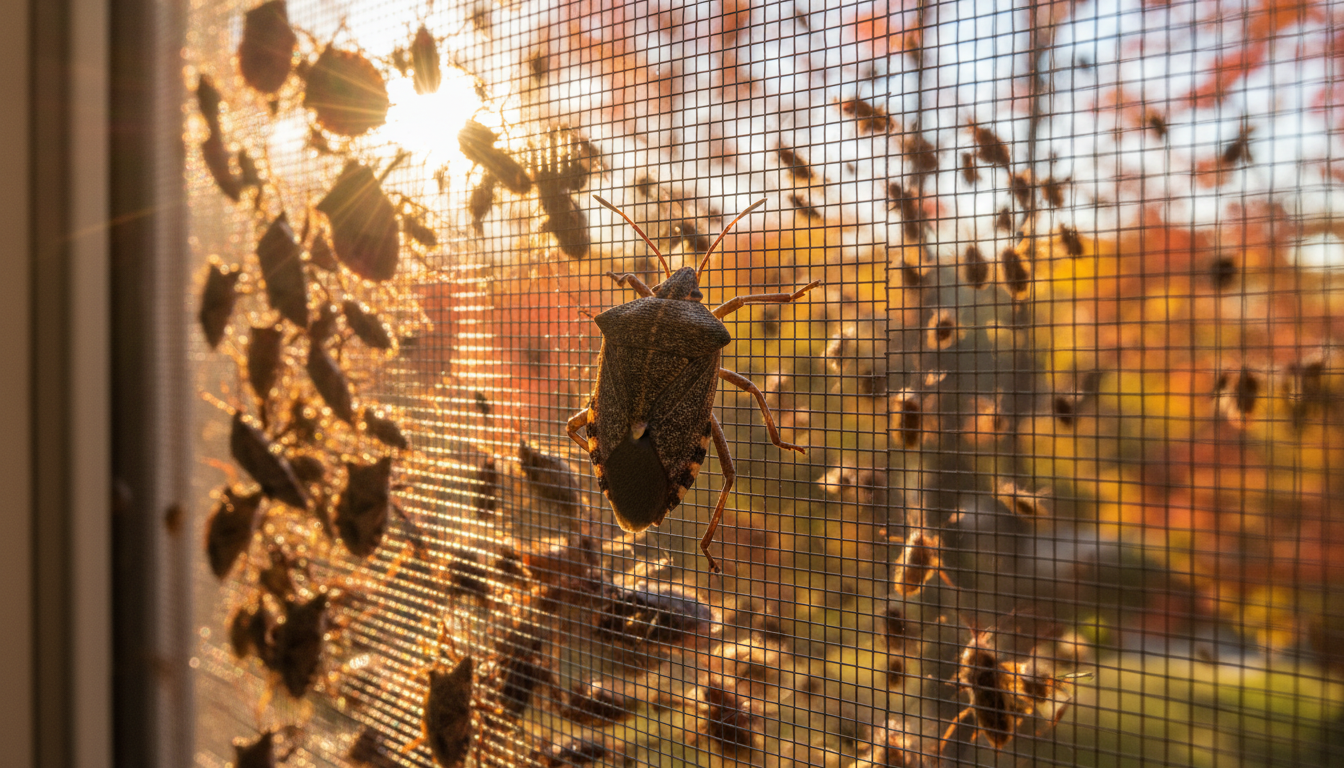
Stink Bugs Are Invading American Homes: Which States Are Hit Hardest
- The brown marmorated stink bug (BMSB), an invasive species from East Asia, has spread to 46+ U.S. states since its first detection in Pennsylvania in 1998.
- NPMA's 2025 fall forecast identified the Great Lakes, Ohio Valley, and Midwest as facing heightened stink bug activity heading into winter.
- Stink bugs aggregate in homes by the thousands using pheromone signals — killing them indoors releases these pheromones and can attract more.
- The agricultural impact is significant: stink bugs cause an estimated $37 million per year in apple crop damage alone.
- Exclusion (sealing entry points) is the only reliable prevention strategy; indoor insecticides are largely ineffective against overwintering stink bugs.
The brown marmorated stink bug (Halyomorpha halys) is one of the most successful invasive insect species in recent American history. First detected in Allentown, Pennsylvania in 1998, it has since spread to 46 or more states and become a major agricultural pest and household nuisance. Unlike most invasive species, which tend to concentrate in specific ecological niches, the BMSB has thrived across a remarkably wide range of climates and environments.
For homeowners, the stink bug problem is defined by one behavior: overwintering. As temperatures drop in autumn, stink bugs seek protected spaces to enter a dormant state called diapause. Homes — warm, sheltered, and abundant — are their preferred overwintering sites. A single home can harbor thousands of stink bugs in wall voids, attics, and crawl spaces.
The Spread: From Pennsylvania to 46+ States
The BMSB's expansion across the United States has been remarkably rapid. The timeline illustrates the challenge of containing an invasive species that travels easily on vehicles, shipping containers, and agricultural products:
- 1998: First detected in Allentown, PA
- 2001: Established in 6 states (Mid-Atlantic corridor)
- 2010: Caused catastrophic agricultural damage in the Mid-Atlantic — some apple orchards reported 90% crop loss
- 2015: Documented in 40+ states
- 2024–2026: Present in 46+ states, with heaviest residential impacts in the Mid-Atlantic, Great Lakes, Ohio Valley, and Midwest
Which States Are Hit Hardest
The NPMA's seasonal Bug Barometer forecasts consistently identify specific regions as facing the highest stink bug pressure:
| Region | Key States | Severity |
|---|---|---|
| Mid-Atlantic | PA, NJ, MD, VA, WV, DE | Very High — original epicenter of the invasion |
| Great Lakes | OH, MI, IN, IL, WI | High — NPMA flagged as heightened activity zone for 2025–2026 |
| Ohio Valley / Appalachia | KY, TN, NC (mountains), southern OH | High — established populations with annual fall invasions |
| New England | CT, MA, NY (upstate), NH, VT | Moderate-High — growing presence |
| Pacific Northwest | OR, WA | Moderate — agricultural concern; growing residential impact |
Why Killing Them Indoors Backfires
The stink bug's defense mechanism — releasing a foul-smelling chemical (trans-2-decenal and trans-2-octenal) when threatened or crushed — is well known. But less commonly understood is the role of aggregation pheromones.
When stink bugs find a suitable overwintering site, they release chemical signals that attract others to the same location. This is why stink bug infestations tend to recur in the same homes year after year, and why some homes are overwhelmed while neighboring properties see few bugs.
Crushing stink bugs or using indoor insecticides can release both the defensive odor and residual pheromone traces that may attract more stink bugs to the same area in subsequent seasons. Pest management professionals recommend vacuuming live bugs (disposing of the bag immediately) rather than crushing them.
Prevention: Exclusion Is the Only Reliable Strategy
Indoor insecticide treatments are largely ineffective against overwintering stink bugs. The bugs are dormant in wall voids and attic spaces where sprays don't reach, and they are not feeding (so baits don't work). Physical exclusion — sealing the entry points they use to get inside — is the only evidence-based prevention strategy.
Key exclusion targets for stink bugs:
- Window and door frames — caulk gaps between frames and siding
- Utility penetrations — seal around pipes, wires, and conduit with silicone caulk
- Attic vents and soffit vents — ensure screens are intact and mesh is fine enough (ideally 1/8 inch or smaller)
- Chimney caps — install or replace with properly screened caps
- Weep holes in brick — cover with fine mesh inserts designed to allow drainage while blocking insects
- Ridge vents — ensure the filter fabric inside ridge vent material is intact
- Light fixtures — exterior wall-mounted lights often have gaps where wiring enters; seal with caulk
The best time to perform exclusion for stink bugs is late August through September, before fall migration begins.
What to Do If They're Already Inside
- Vacuum them up — use a shop vacuum or dedicate a vacuum bag to stink bug collection. Dispose of the bag immediately to prevent odor
- Use a soapy water trap — a shallow pan with soapy water placed under a desk lamp attracts and drowns stink bugs at night
- Seal interior entry points — stink bugs enter living spaces from wall voids through gaps around outlets, light switches, and ceiling fixtures. Foam gaskets behind outlet covers can help
- Do not use bug bombs or foggers — these are ineffective against stink bugs in wall voids and contaminate living spaces unnecessarily
Agricultural Impact
Beyond the household nuisance, BMSB is a devastating agricultural pest. It feeds on more than 100 plant species, including many commercially important crops:
- Apples: Estimated $37 million/year in crop damage
- Peaches, pears, and stone fruit: Significant losses in the Mid-Atlantic
- Sweet corn and peppers: Growing concern in the Midwest
- Soybeans: Documented feeding damage in multiple states
Biological control research has identified a parasitoid wasp (Trissolcus japonicus, or "samurai wasp") native to Asia that specializes in parasitizing BMSB eggs. USDA-approved releases of this wasp are underway in several states, and early results suggest it may eventually help reduce stink bug populations — though the full impact will take years to develop.
In the meantime, for homeowners in affected regions, fall exclusion work remains the single most effective defense against the annual invasion.
Related Articles

Why Pest Control Companies Are Booming: Industry Trends for 2026
Key Takeaways The U.S. pest control industry generates over $24 billion in annual revenue and has ...

Pest Control for New Homeowners: Your First-Year Checklist
Key Takeaways Schedule a professional pest inspection within the first 30 days of homeownership — ...
How Much Does Pest Control Cost in 2026? A Complete Pricing Guide
Key Takeaways The average one-time pest control treatment costs $150–$350, while quarterly service...