
Spring Ant Invasion: Why Ants Take Over Your Kitchen and How to Stop Them
- Ants are the #1 household pest complaint in the U.S., and spring is when most infestations begin as colonies send scouts indoors searching for food and water.
- The three most common kitchen invaders are odorous house ants, pavement ants, and carpenter ants — each requires a different control strategy.
- Killing visible ants with spray actually makes the problem worse by triggering "budding," where the colony splits and creates multiple new satellite nests.
- Bait stations are the most effective DIY method because foraging ants carry the bait back to the queen, eliminating the entire colony.
- Sealing entry points and eliminating moisture sources are the two highest-impact prevention steps you can take before ant season hits.
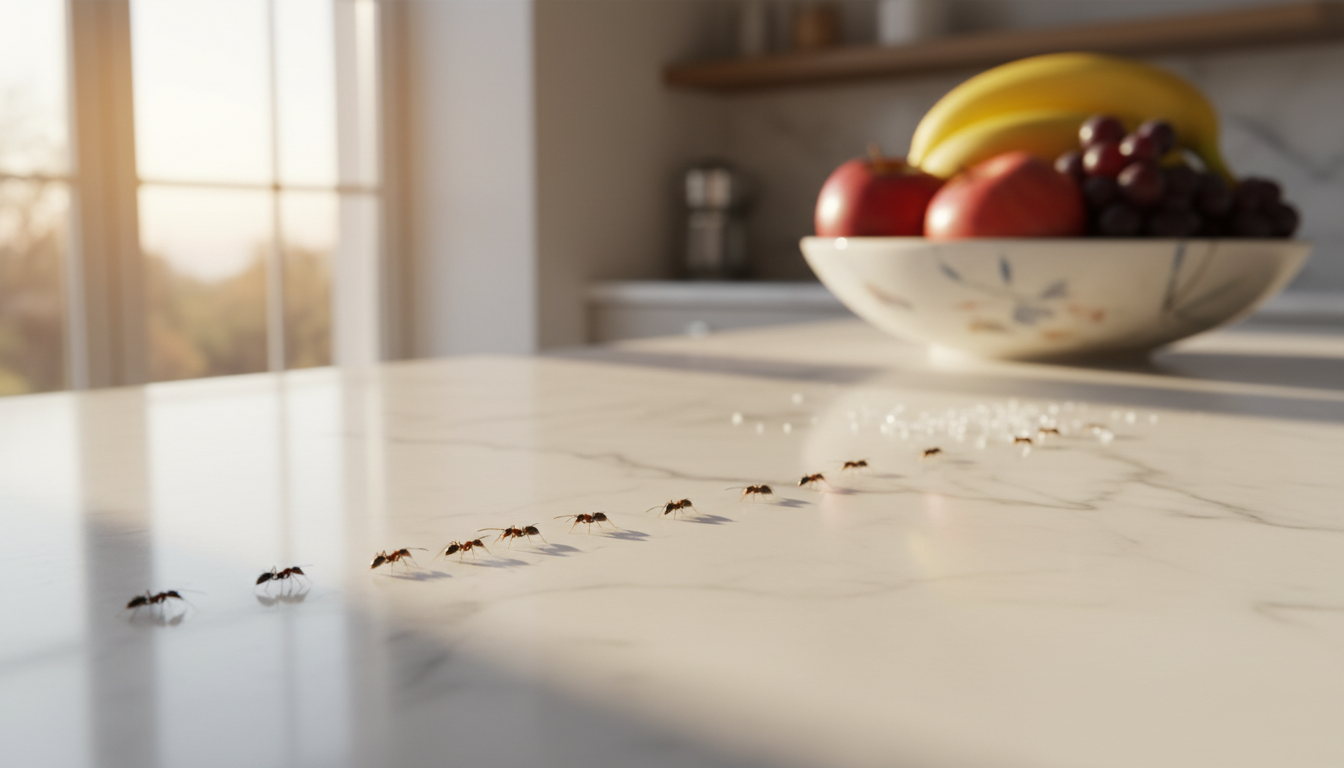
Every spring, millions of homeowners wake up to the same unwelcome sight: a trail of tiny ants marching across their kitchen counter. Ants are the most common household pest in America, and the spring invasion is not random — it is driven by predictable biological triggers that you can work against once you understand them.
This guide covers why ants invade kitchens specifically, which species you are most likely dealing with, the DIY methods that actually work (and the ones that backfire), and when it is time to call a professional.
Why Spring Triggers Ant Invasions
Ant colonies that survived winter in soil, mulch beds, or wall voids begin ramping up activity when soil temperatures consistently reach 50–60°F. The queen increases egg production, and the colony sends out scout ants to locate new food and water sources. Your kitchen is an ideal target because it offers both in abundance.
Several factors make spring 2026 particularly bad for ant activity:
- Mild winter temperatures: A warmer-than-average winter across much of the U.S. means more colonies survived with larger populations intact.
- Spring rainfall: Heavy rain saturates outdoor nesting sites, literally flooding ants indoors. If you notice ants after a rainstorm, this is why.
- Earlier warm-up: Colonies that activate earlier have more time to establish foraging trails into homes before summer.
Identifying Your Ant Species (It Matters for Treatment)
Not all ants respond to the same treatment. Spraying a carpenter ant trail with over-the-counter repellent, for example, will scatter the colony and make the problem significantly harder to solve. Here are the three species most likely to appear in your kitchen:
Odorous House Ants (the most common)
Tiny (1/16–1/8 inch), dark brown or black. Crush one and it smells like rotten coconut. They form long, visible trails to food sources — especially sweets, fruit, and grease. Colonies can contain 100,000+ workers with multiple queens, making them persistent invaders.
Best approach: Sweet liquid bait stations placed along trail paths. Do NOT spray — it causes colony budding.
Pavement Ants
Small (1/8 inch), dark brown with parallel grooves on the head (visible with magnification). They nest in cracks in foundations, driveways, and under slabs. You will often see small mounds of displaced soil near entry points.
Best approach: Protein-based baits in spring (they crave protein after winter), switching to sweet baits in summer. Seal foundation cracks with silicone caulk.
Carpenter Ants
Large (1/4–1/2 inch), black or dark red. Unlike termites, they do not eat wood — they excavate it to build nests, leaving behind sawdust-like frass. A carpenter ant problem often indicates a moisture issue in your home's structure.
Best approach: Professional treatment is strongly recommended. Carpenter ant colonies have a main nest (often in a tree or stump outside) and satellite nests inside walls. Eliminating only the indoor ants will not solve the problem.
DIY Ant Control Methods That Actually Work
The most effective DIY approach combines immediate bait treatment with long-term exclusion. Here is a step-by-step process:
Step 1: Follow the Trail (Do Not Wipe It Up Yet)
Ant trails are chemical highways — pheromone paths that guide other ants to a food source. Before you clean anything, follow the trail in both directions. Find where they are entering your home (the entry point) and where they are headed (the food source). This tells you where to place bait and where to seal.
Step 2: Place Bait Stations Along the Trail
Place liquid ant bait stations (Terro is widely available and effective) directly on or adjacent to the active trail. You will see ant activity increase around the bait station for 2–3 days as more workers discover it. This is a good sign — they are carrying bait back to the colony. Resist the urge to spray or disturb the trail during this period.
Step 3: Eliminate the Food Source
While the bait works, remove whatever attracted the ants in the first place. Common kitchen attractants include:
- Fruit left on the counter (especially bananas and overripe produce)
- Pet food bowls left out overnight
- Sticky residue from spills under appliances
- Recycling bins with sugary residue
- Grease buildup behind the stove
Step 4: Seal Entry Points
Once you have identified where ants enter, seal those gaps permanently. Common entry points include:
- Gaps where pipes or wires penetrate exterior walls
- Cracks at the foundation-siding junction
- Deteriorated weatherstripping around doors and windows
- Gaps where the countertop meets the backsplash
Use silicone caulk for most gaps. For larger openings around pipes, use copper mesh stuffed into the gap and sealed with expanding foam.
Step 5: Clean the Pheromone Trail
After the bait has been working for 3–5 days and ant activity declines, clean the trail path with a vinegar-water solution (1:1 ratio) or soapy water. This destroys the pheromone trail and prevents new scouts from following it.
What NOT to Do (Common Mistakes)
- Do not spray visible ants with insecticide. Repellent sprays scatter foraging ants, disrupt their trail back to the nest, and trigger budding — the colony splits into multiple smaller colonies, each with its own queen. You go from one problem to several.
- Do not use vinegar as a standalone solution. Vinegar disrupts pheromone trails temporarily, but it does not kill ants or affect the colony. They will re-establish trails within hours.
- Do not rely on cinnamon, peppermint oil, or other "natural deterrents" alone. While some essential oils have mild repellent effects, they do not address the colony. The ants simply find a different path.
- Do not ignore moisture problems. Ants need water. A dripping pipe under the kitchen sink, condensation on windows, or a leaking dishwasher can sustain an ant colony indefinitely — even after you remove all food sources.
When to Call a Professional
DIY bait treatment resolves most common ant invasions within 1–2 weeks. Call a licensed pest control professional if:
- You see large black ants (1/4 inch or larger) — likely carpenter ants, which cause structural damage
- You find sawdust-like piles (frass) near baseboards, window frames, or door frames
- Ant activity persists for more than 2–3 weeks despite bait treatment
- Ants reappear in different locations after initial treatment (suggests multiple satellite nests)
- You see winged ants (swarmers) indoors — this means a mature colony is nesting inside your home
Professional ant treatment typically costs $150–$300 for an initial treatment and $50–$75 for follow-up visits. For carpenter ants, expect $300–$500+ depending on the extent of nesting.
Ready to find a pest control professional in your area? Get free quotes from licensed local exterminators on PestControlBoard — compare prices, read reviews, and hire with confidence.
Frequently Asked Questions
Why do ants keep coming back after I clean everything?
Cleaning removes the food source but does not address the colony. The queen continues producing workers who scout for new food sources. Until the colony is eliminated (through baiting that reaches the queen) or fully excluded (all entry points sealed), scouts will keep appearing. Persistent reappearance often means the colony is nesting inside your walls rather than outside.
Are ants dangerous?
Most kitchen ants (odorous house ants, pavement ants) are nuisance pests — they do not bite, sting, or transmit diseases. Carpenter ants are the exception: they cause structural damage by excavating wood for nesting. Fire ants (more common in southern states) deliver painful stings that can cause allergic reactions.
How long does ant bait take to work?
Expect to see increased ant activity around bait stations for the first 2–3 days (this is normal and means it is working). Activity typically decreases noticeably by days 5–7 and should be eliminated within 2 weeks. Replace bait stations that dry out. If there is no improvement after 2 weeks, you may need to switch bait types (some colonies prefer protein over sugar) or consult a professional.
Can ants damage my home?
Carpenter ants can cause significant structural damage over time by hollowing out wood for nesting. They prefer moist, softened wood, so their presence often indicates a water damage issue that should also be addressed. Other common kitchen ants do not cause structural damage.
Do ultrasonic pest repellers work on ants?
No. Multiple independent studies, including research published by the Federal Trade Commission, have found that ultrasonic pest repellers have no measurable effect on ant behavior or colony activity. Save your money for bait stations and caulk.
Related Articles

Why Pest Control Companies Are Booming: Industry Trends for 2026
Key Takeaways The U.S. pest control industry generates over $24 billion in annual revenue and has ...

Pest Control for New Homeowners: Your First-Year Checklist
Key Takeaways Schedule a professional pest inspection within the first 30 days of homeownership — ...
How Much Does Pest Control Cost in 2026? A Complete Pricing Guide
Key Takeaways The average one-time pest control treatment costs $150–$350, while quarterly service...