
Carpenter Ants vs. Termites: How to Tell the Difference (and Why It Matters)
- Carpenter ants excavate wood to build nests but do not eat it; termites consume wood as their primary food source.
- Misidentifying these pests delays proper treatment by an average of 6–12 months, during which structural damage compounds.
- Carpenter ant treatment typically costs $250–$500, while termite treatment ranges from $225 to $2,500+.
- Termites cause an estimated $5 billion in property damage annually in the United States.
- A simple visual inspection of the insect's body shape, wing size, and antennae can usually distinguish the two.
Discovering wood damage in a home triggers an immediate question: carpenter ants or termites? The answer matters enormously — not just for treatment approach, but for cost, urgency, and long-term structural implications. According to industry data, misidentification is one of the most common reasons homeowners delay effective treatment, often by 6 to 12 months while using the wrong products or strategies.
Physical Identification: Side by Side
The fastest way to distinguish these two pests is by examining the insect itself. Despite both being small and sometimes winged, there are clear physical differences visible to the naked eye.
| Feature | Carpenter Ant | Termite |
|---|---|---|
| Body shape | Pinched waist, clearly segmented | Thick, straight waist, no visible segmentation |
| Antennae | Elbowed (bent) | Straight, bead-like |
| Wings (swarmers) | Front wings longer than hind wings | All four wings equal in length |
| Color | Black, dark brown, or reddish | Creamy white (workers), dark brown/black (swarmers) |
| Size | 6–13 mm (larger) | 3–6 mm (smaller workers) |
Damage Patterns: How to Read the Evidence
Even when the insects themselves aren't visible, the damage they leave behind tells a distinct story.
Carpenter Ant Damage
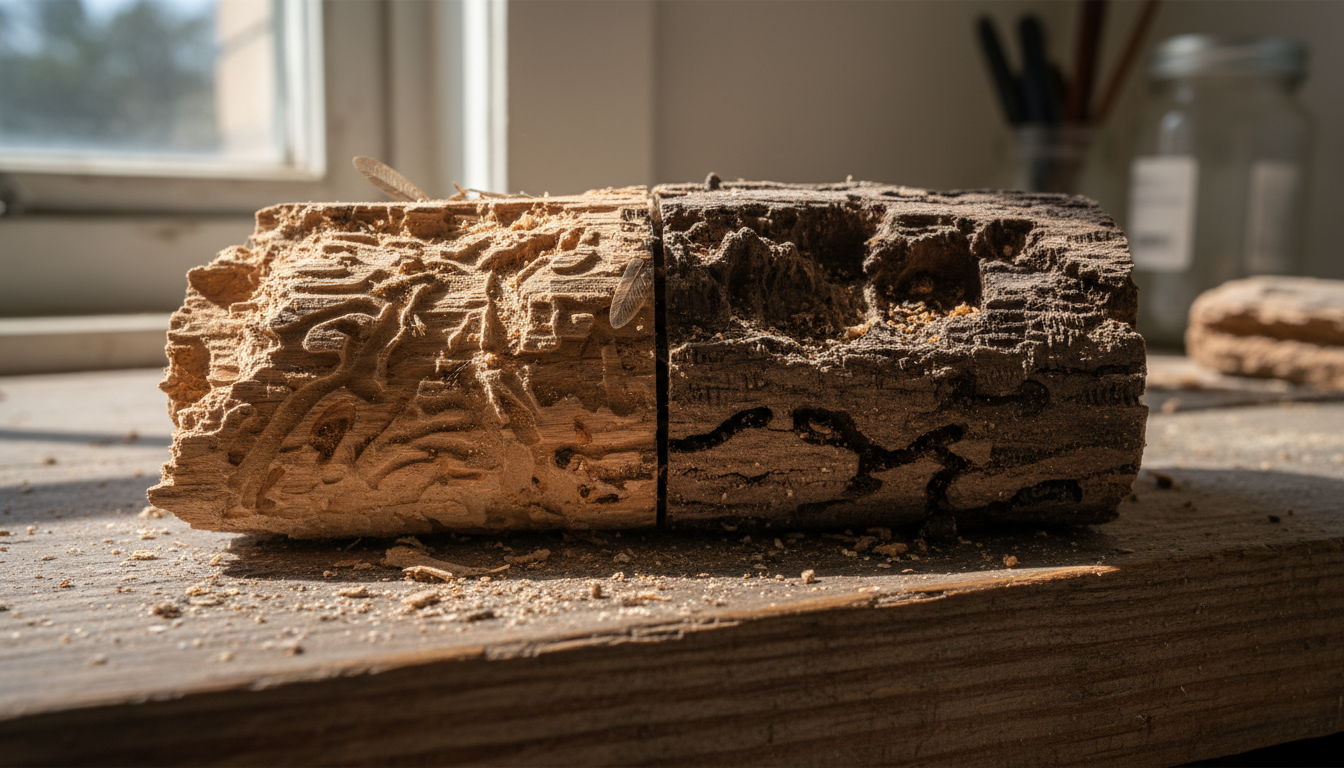
- Galleries are smooth, clean, and sandpaper-like inside — they look almost polished
- Small piles of frass (sawdust-like debris mixed with insect body parts) appear below entry points
- Damage tends to concentrate in moist, softened wood — around windows, under sinks, near roof leaks
- Carpenter ants prefer wood that's already compromised by moisture or decay
Termite Damage
- Galleries are rough, ragged, and packed with mud or soil
- Mud tubes (pencil-width tunnels made of soil and saliva) on foundations are a signature sign of subterranean termites
- Damage is often hidden behind intact surface wood — a thin outer layer may be all that remains
- Termites eat wood along the grain, creating a layered, honeycomb-like pattern
- Drywood termites leave behind small, hard, pellet-shaped fecal droppings (frass) that look like tiny seeds
Behavioral Differences
Understanding how these pests live explains why they cause such different types of problems.
Carpenter ants do not eat wood. They excavate it to create nesting galleries, then forage for food sources like sweets, proteins, and other insects. A mature colony contains 10,000–50,000 workers. They are most active at night and may travel 100 yards or more from the nest to forage. Seeing large black ants in the kitchen at night is a common early indicator.
Termites consume cellulose — the organic fiber in wood — as their primary food source. A subterranean termite colony can contain 60,000 to over 1 million individuals. Worker termites forage 24 hours a day, 365 days a year. Because they live entirely within their food source or underground, they are rarely seen until damage is extensive or swarmers emerge.
The Cost Difference
| Factor | Carpenter Ants | Termites |
|---|---|---|
| Treatment cost | $250–$500 | $225–$2,500+ |
| Repair cost (average) | $500–$2,000 | $3,000–$8,000+ |
| Annual U.S. damage | ~$300 million | ~$5 billion |
| Insurance coverage | Rarely covered | Almost never covered |
| Ongoing monitoring | $100–$200/year | $150–$400/year |
Treatment Approaches
Carpenter Ant Treatment
Effective carpenter ant control requires locating and treating the nest directly. Professionals typically use a combination of:
- Dust insecticides injected into wall voids and nest galleries
- Perimeter barrier treatments around the home's foundation
- Bait systems for satellite colonies
- Moisture remediation — fixing the water source that attracted them is essential for long-term control
Termite Treatment
Termite treatment is more complex and depends on the species:
- Liquid barrier treatments (termiticides like fipronil) create a chemical barrier in the soil around the home's foundation — effective for 5–10 years
- Bait station systems placed in the ground around the perimeter, monitored and maintained quarterly
- Fumigation (tenting) for drywood termites — the entire structure is sealed and filled with gas, typically costing $1,200–$3,500 for an average home
- Spot treatments for localized drywood termite infestations — $200–$600 per area
When to Call a Professional
For carpenter ants, a professional inspection is recommended when:
- Large black ants are repeatedly seen indoors, especially at night
- Frass piles (fine sawdust) appear near baseboards, window frames, or joists
- Rustling sounds are heard inside walls
For termites, professional intervention is considered essential in virtually all cases. Warning signs include:
- Mud tubes on foundation walls, piers, or crawl space surfaces
- Hollow-sounding wood when tapped
- Swarmers (winged insects) emerging indoors, often near windows in spring
- Doors or windows that suddenly stick or won't close properly
- Bubbling or peeling paint that resembles water damage
The bottom line: both pests destroy wood, but termites do it faster, on a larger scale, and at far greater cost. Correct identification from the start is the single most important factor in minimizing damage and expense.
Related Articles
Why Pest Control Companies Are Booming: Industry Trends for 2026
Key Takeaways The U.S. pest control industry generates over $24 billion in annual revenue and has ...

Pest Control for New Homeowners: Your First-Year Checklist
Key Takeaways Schedule a professional pest inspection within the first 30 days of homeownership — ...
How Much Does Pest Control Cost in 2026? A Complete Pricing Guide
Key Takeaways The average one-time pest control treatment costs $150–$350, while quarterly service...